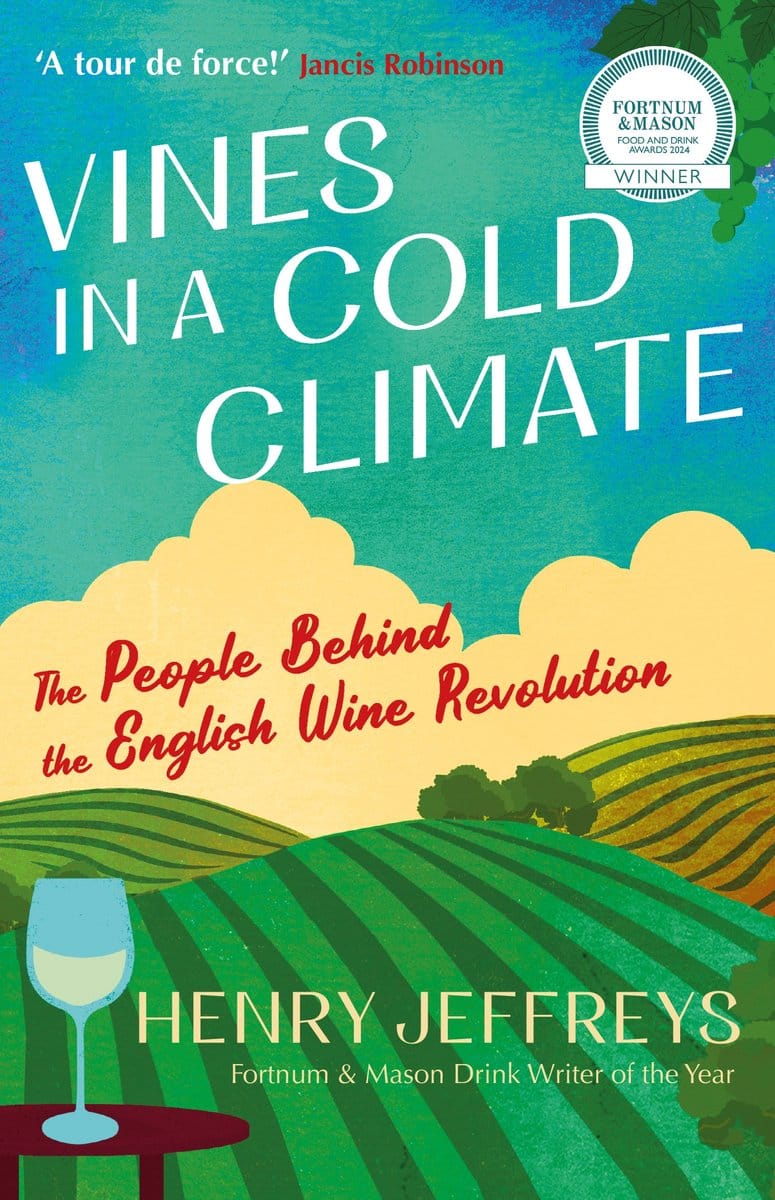
Book Notes: Henry Jeffreys – Vines in a Cold Climate (2023)
About the Author
Henry Jeffreys studied English and Classical Literature at Leeds, worked in the wine trade and in publishing, and was wine critic for The Lady before turning to drinks writing full-time. He was features editor of the Master of Malt blog (2018–2024), is drinks columnist for The Critic, and contributes to the Guardian, Spectator and BBC Good Food. Fortnum & Mason named him Drink Writer of the Year 2022/23. Earlier books: Empire of Booze (2016), The Home Bar (2018), The Cocktail Dictionary (2020). He lives in Faversham, Kent – which puts him a short drive from Domaine Evremond, Simpsons and Chapel Down, and explains the road-trip texture of the book.
On method, Jeffreys has since written that he began the book in 2022 knowing almost none of the producers personally, and that keeping distance from the hospitality is what allows the business chapters to stay unsentimental.
- Substack: Drinking Culture (newsletter on alcohol, culture and history)
- Podcast: Intoxicating History, with Tom Parker Bowles (since late 2024)
- Agent bio: Greyhound Literary
- Instagram: @henrygjeffreys
- LinkedIn: Henry Jeffreys
About the Book
Not a guidebook. Skelton, Clarke and Dallimore already cover the where-to-visit format (see Relevant Literature below); Jeffreys writes reportage. Each chapter is built round visits and interviews – Peter Hall at Breaky Bottom, the Mosses who planted Nyetimber, Frazer Thompson fending off bailiffs at Chapel Down, Patrick McGrath on why Taittinger bought land rather than a winery – and the chapters read as standalone essays, which is both the charm and the limitation reviewers noted.
Two threads run through the whole book. First, money: who paid for the vineyards (retired majors, hedge-fund alumni, Dutch and American investors, Champagne houses) and whether any of it has yet earned a return. Second, the argument about what English wine should be – traditional-method sparkling on chalk, or still Chardonnay and Pinot Noir on Essex clay.
Chapter Summary
- Introduction. Taittinger planting vines outside Faversham in May 2017, a week after frost took up to 80% of some crops; the “Judgement of Parsons Green” (2011) and the 2016 Paris tasting; how the author came round first to the sparklers, then to the stills.
- False starts. Roman and medieval traces, Painshill in the 18th century, and Edward Hyams – historian, novelist, Soil Association founder – who found the Wrotham Pinot growing against a Kent wall.
- The bloody awful weather years. Peter Hall at Breaky Bottom (planted 1974), Stephen Skelton on the “crusty major-generals”, and why German crosses (Müller-Thurgau, Seyval Blanc, Reichensteiner) were the only rational choice.
- Ambition and money. Stuart and Sandy Moss, Chicago Americans who bought Nyetimber in 1986 and planted only Chardonnay, Pinot Noir and Meunier – the decision that set the Champagne model.
- Bubbling under. Tony Laithwaite’s Theale vineyard on a rubble heap by the M4; Ridgeview and the Roberts family; the first international trophies.
- Not going tits up. Chapel Down from Isle of Wight origins to a £100m AIM-listed company; Frazer Thompson and Owen Elias.
- Money men. Eric Heerema’s purchase and rebuilding of Nyetimber; the Wine Garden of England group in Kent; who is actually funding the boom.
- Foreign affairs. Pommery’s Louis Pommery England with Hattingley Valley; Taittinger and Hatch Mansfield buying land at Chilham; Didier Pierson beating them all to it in 2005.
- Fizz wars. The Charmat controversy – why Charlie Holland at Gusbourne and others think tank-method English fizz could damage the category; a history of how Champagne learned to sparkle.
- Big wine. Around 500 growers but only about 100 producers: contract winemaking at Hambledon, Hattingley, Three Choirs and Halfpenny Green.
- Small wine. Ben Walgate’s Tillingham – qvevri, flor, sourdough pizza – and what “natural” means in East Sussex.
- Organic growth. Will Davenport, one of very few certified organic growers, on mildew, weeds and why organics in a damp climate is science rather than hippiedom.
- Grape expectations. Bacchus versus the Burgundy varieties; the case, argued by Sergio Verrillo among others, that the crosses have no future.
- Eastern promise. Essex and the Crouch Valley: London clay rather than chalk, the ripest fruit in England, John Atkinson at Danbury Ridge looking for “our Pétrus”.
- Urban wineries. Railway arches and the drinks trade; Chris Wilson at Gutters & Stars; Blackbook and other London cellars buying in English fruit.
- Tourist attractions. Oastbrook, Tillingham-as-Soho-House, and the shift from vineyard to visitor business.
- Reaching the customer. Ruth and Charles Simpson, who priced Central Otago and Margaret River before choosing Kent; distribution, supermarkets, cellar door.
- Storm clouds ahead. The 2022 glass shortage after Verallia’s Ukrainian plant closed; Brexit, labour, inflation.
- Warming up. Climate change as opportunity and hazard; frost; Bob Lindo of Camel Valley on the “creeping catastrophe”.
- Good for England. The sceptics’ case (Alder Yarrow, an unnamed Australian at the London Wine Fair) and Jeffreys’ own verdict on where quality stands.
Reviews
The book was widely reviewed in the UK national press on publication; the publisher collects the quotes. Independent reviews with more to say:
- Simon Heffer, Literary Review – on the money that has gone into (and out of) English vineyards, and the discovery that north-east Essex is prime terroir
- Decanter (2024 books round-up) – affable and award-laden, with fair caveats: repetition between essay-chapters, typos, thin wider context
- Simon J Woolf, The Morning Claret – places the book against the 2019–2023 guidebook cluster (Skelton, Clarke, Dallimore, Moulton & Bell)
- David Crossley, Wide World of Wine – credits Jeffreys for asking whether every £40–50 English sparkler earns its price
English Wine: The Wider Picture
The book closes its research in 2022. The figures below are the current ones, so the reader can see how far the story has moved in three years.
Key figures
| Theme | 2021 (book era) | 2025/26 | What changed |
|---|---|---|---|
| Scale | c. 3,800 ha, c. 900 vineyards | 4,841 ha, 1,158 vineyards | Growth continues but slower than the 2015–20 planting rush the book describes |
| Output vs. weather | 8.95 m bottles; 13.2 m peak (2018) | 10.7 m (2024) → 16.5 m (2025) | Vintage swings of ±50% remain the defining fact; 2025 was the ripest harvest recorded |
| Sparkling vs. still | 70 / 30 | 70 / 30 | Still wine has not gained share, despite the Essex narrative of chapter 13 |
| Market | 9.3 m bottles sold | 9.1 m sold (2024); exports 9% | Sales flat while output rises — the stock overhang Jeffreys anticipates in “Storm clouds ahead” |
| Geography & grapes | Chalk counties; Champagne trio = 71% of plantings | Essex now third county; Chardonnay 33%, Pinot Noir 30%; 99 varieties | Clay is winning plantings; the German crosses of chapter 12 are fading |
Sources:
- WineGB – Data (Wine Standards 2025/2026 figures)
- WineGB Industry Report 2025 (public version, PDF)
- WineGB press release, 28 July 2025 – grape mix, county ranking, sales channels
- WineGB, 25 March 2026 – 2025 Harvest Report (Stephen Skelton MW) and FSA production data
- 2021 comparison figures: Harpers, August 2022 (secondary)
Appellations
England has no Champagne-style hierarchy; it has one county PDO and a queue. Sussex entered the UK GI register on 5 July 2022 – the application dated from 2015, was cleared by DEFRA in 2016 and then waited on Brussels until Brexit made it a domestic decision. Sussex sparkling must spend at least 15 months on lees and pass a tasting panel. Jamie Goode argued against it at the time on the grounds that county boundaries are not terroir. The Crouch Valley (Essex) applied for PDO status on 7 March 2023 and, as of January 2026, is still listed as “under consideration” – the regulatory expression of chapter 13. A Natural Wine of Wales PGI application followed in August 2025.
Sources:
- GOV.UK – Sussex PDO (product specification and decision notice)
- GOV.UK – The Crouch Valley (pending)
- GOV.UK – protected wine names: applications
- Rathfinny – the Sussex PDO ratified (producer view, rules summarised)
- Jamie Goode – against the Sussex PDO
The producers, three years on
Several of the book’s cliffhangers have resolved.
Domaine Evremond (Taittinger & Hatch Mansfield), Chilham, Kent
The vines Jeffreys watched being planted in 2017 became a winery, two-thirds underground, opened by the Duchess of Edinburgh on 26 September 2024. Classic Cuvée Edition I (55% Pinot Noir, 35% Chardonnay, 10% Meunier; 2020 base with 2019 reserve; disgorged August 2024) was released in spring 2025 at £50. Edition II followed in 2026.
- Taittinger – Evremond
- Decanter – Domaine Evremond officially opens (October 2024)
- Wine Anorak – first release (January 2025)
- Joanna Simon – Edition II (August 2026)
Gusbourne, Appledore, Kent
Founded 2004 by Andrew Weeber; Lord Ashcroft’s vehicle became majority owner. In 2024 Ashcroft put the company up for sale; no buyer emerged, and Gusbourne delisted from AIM in February 2025 to concentrate on direct-to-consumer sales. Ranked among the top three in the 2026 Top Wineries of Great Britain tasting.
Chapel Down, Tenterden, Kent
England’s largest producer ran a strategic review in June 2024 that included a possible sale; it concluded in October 2024 with the company staying independent on AIM, a weak 2024 harvest warning and a new winery planned for the 2026 vintage.
Nyetimber, West Chiltington, West Sussex
Eric Heerema’s estate (chapter 6) took Champion Sparkling Wine and Sparkling Winemaker of the Year (Cherie Spriggs) at the International Wine Challenge 2025, and placed first in the 2026 Top Wineries of Great Britain blind tasting judged by Anthony Rose, Young Shi and Rosemary George MW.
Essex: Danbury Ridge and the Crouch Valley
Chapter 13’s prediction is holding. Essex is now the third most planted county; Danbury Ridge announced a joint venture with Domaine Duroché of Gevrey-Chambertin in 2026, and Jackson Family Wines’ Essex label Marbury released a first Pinot Noir from the 2024 vintage.
Relevant Literature
The book arrived at the end of a five-year run of English-wine titles. Read together they divide into guidebooks, a coffee-table book, and this one piece of narrative reporting.
- Stephen Skelton MW – Wine of Great Britain (Infinite Ideas, 2019): the reference-textbook account by the industry’s vineyard consultant; Skelton also writes the annual WineGB Harvest Report. See also Stephen Skelton – Viticulture (2019) | Book Notes.
- Oz Clarke – English Wine: From Still to Sparkling (2nd revised ed., Pavilion, 2022): the enthusiast’s regional tour.
- Ed Dallimore – The Vineyards of Britain (Fairlight, 2022): 140 estates, all visited.
- Abbie Moulton & Maria Bell – New British Wine: New Makers, New Flavours, New Ethos (Hoxton Mini Press, 2023): photographic portraits of the still-and-natural generation that Jeffreys covers in chapters 10 and 14.
- Jamie Goode – Regenerative Viticulture (2022): background to chapter 11; see also Flawless – Jamie Goode (2018) | Book Notes.
- Anthony Rose – Fizz (Infinite Ideas, 2021): the global sparkling context.
- Tony Laithwaite – Direct: The Story of Laithwaites (Profile, 2019): the Theale vineyard of chapter 4, from the founder’s side.
- Hugh Barty-King – A Tradition of English Wine (1977) and George Ordish – Vineyards in England and Wales (1977): the pre-revolution histories Jeffreys draws on for chapters 1–2.
Videos & Podcasts
- The Drinking Hour, episode 121 (David Kermode, Club Oenologique, August 2023) – on the “difficult characters” and the 2018 vintage as the arrival of English still wine
Related Reading on Tessender
- A Year in Champagne (2014) | Film Notes – the model England is measured against
- Corpinnat (Barcelona) | Wine Region Notes and Franciacorta | Wine Region Notes – two other traditional-method regions defining themselves against Champagne
- Alex Maltman – Vineyards, Rocks, and Soils (2018) | Book Notes – the chalk-versus-clay question in chapter 13, from a geologist
- Wijn van Nederlandse bodem (2015) | Book Notes – the cool-climate story across the North Sea
- Oz Clarke – Story of Wine (2023) | Book Notes
Last updated: September 2026