Basque Country | Wine Region Notes
At a Glance
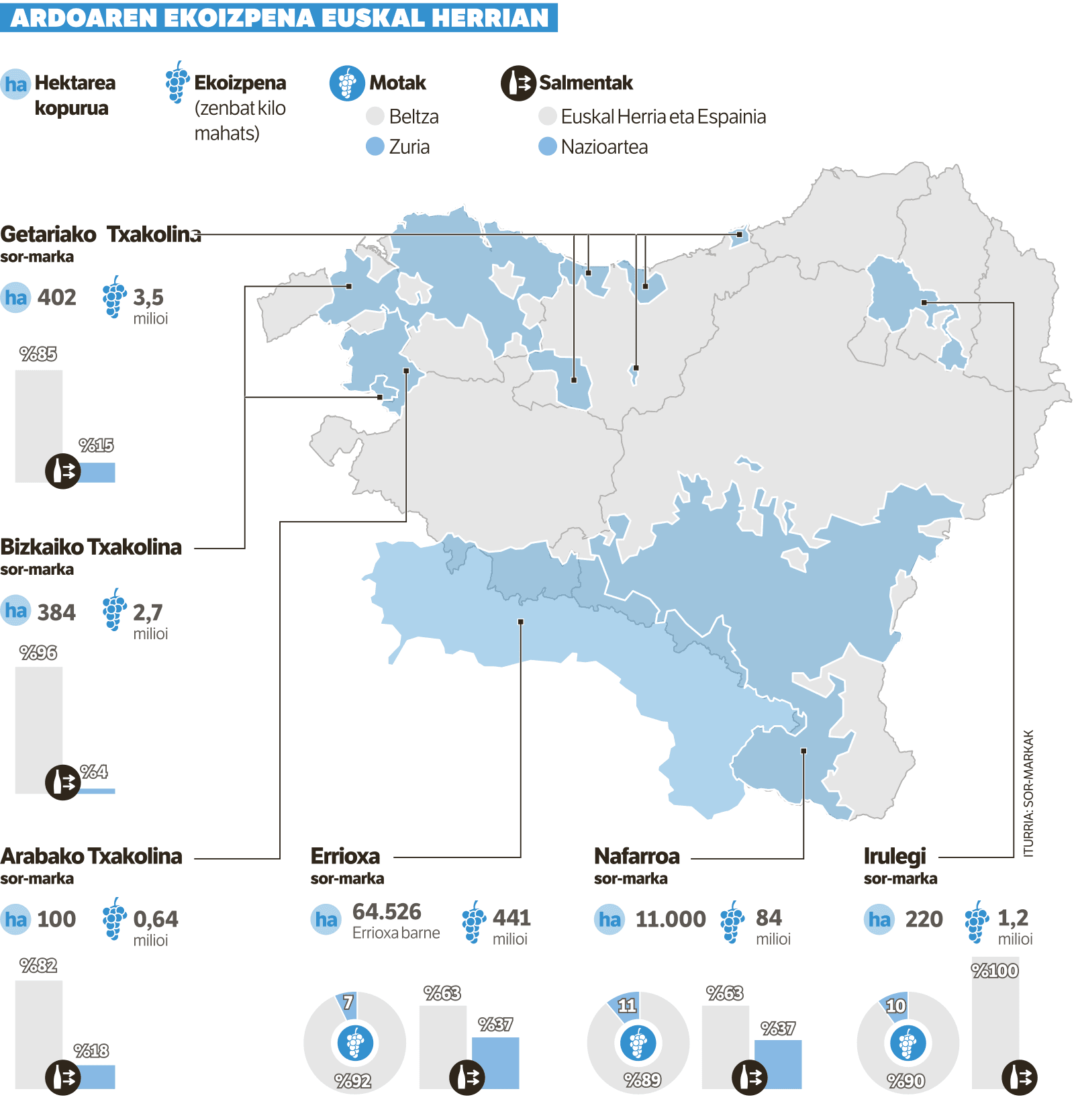
| Location | The Basque Country spans the western Pyrenees and the Bay of Biscay, and what it includes is as much a political question as a geographic one. The map above, Ardoaren ekoizpena Euskal Herrian (“wine production in the Basque Country”), shows the seven historical territories of Euskal Herria — roughly, “the country of Basque speakers.” Four lie in Spain, three in France. In Spain, Álava, Bizkaia and Gipuzkoa are provinces that together form the autonomous community of País Vasco (Euskadi); Navarra is a separate, single-province autonomous community. In France, Lapurdi (Labourd), Nafarroa Beherea (Basse-Navarre) and Zuberoa (Soule) have no administrative status of their own: they sit within the département of Pyrénées-Atlantiques and, since 2017, are grouped in the Communauté d’agglomération du Pays Basque. This article is about wine, not politics; for the wider background, see Related reading. |
| Wine classifications | DO Navarra (1933), AOC Irouléguy (1970), DO Getariako Txakolina (1989), DO Bizkaiko Txakolina (1994), DO Arabako Txakolina (2001), DOCa Rioja (Rioja Alavesa zone), |
| Other classifications | DO Euskal Sagardoa (cider, first seal from the 2016 harvest), IGP Pacharán Navarro (spirits, consejo est. 1988) |
| Key grapes | Hondarrabi Zuri, Hondarrabi Beltza, Tempranillo, Tannat, Cabernet Franc, Petit Courbu, Gros Manseng |
| Wine styles | High-acid still whites (often with light spritz), carbonic-maceration reds, structured mountain reds and rosés, natural cider, sloe liqueur, vermouth |
| Governing bodies | Consejos reguladores per DO; Syndicat des Vins d’Irouléguy / INAO for Irouléguy |
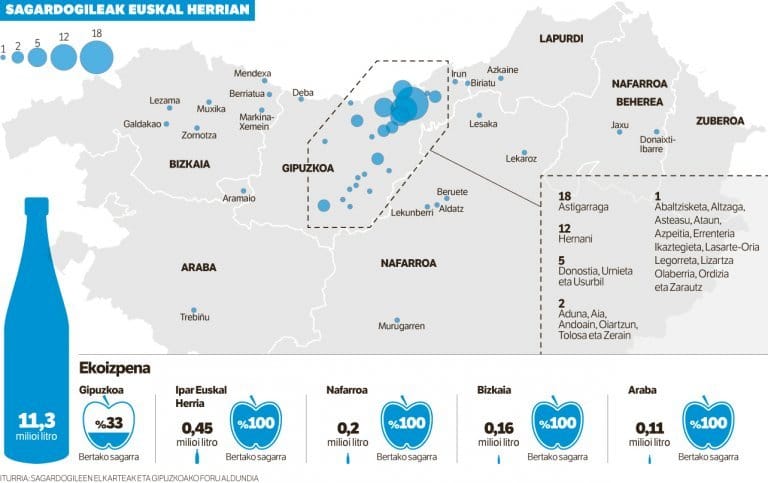
The Basque Country’s drinks appellations are divided between two countries and three regulatory systems. In the Atlantic provinces the everyday ferment has historically been cider, not wine: the Basque Country produces about 13 million litres of sagardoa annually, some 90% of it in Gipuzkoa.
Txakoli: three DOs on the Atlantic
Txakoli is a pale, high-acid white, typically 9.5–11.5% abv, often with a light natural spritz, traditionally poured from height (escanciado). Until the mid-nineteenth century it was a well-regarded regional wine, red and white; the arrival of oidium (powdery mildew) in 1853 made cultivation uneconomic in so humid a climate, red production was abandoned, and white survived mainly in Getaria. For a century it was a cheap, very low-alcohol local commodity. The revival began in the 1990s — modern trellising, precision viticulture, work on indigenous varieties — and ran through three denominaciones de origen, created in sequence as each province rebuilt its vineyard.
The high pour aerates the wine, releases its natural residual CO₂ and lifts the aromatics; it is poured into short, wide tumblers rather than conventional wine glasses. The technique is recommended specifically for Getariako Txakolina, whose wines carry the highest natural carbonation of the three DOs. Basque cider (txotx) is dispensed differently: it runs from a fixed barrel tap at roughly head height into a glass moved from low to high, rather than poured from an elevated bottle.
Getariako Txakolina (Gipuzkoa) is the oldest and the reference. The Basque government recognised the DO by order of 21 September 1989, with Spanish national ratification in 1990 — which explains why sources cite both years. Originally limited to Getaria, Aia and Zarautz, it was extended to the whole province in 2007. About 400 hectares are planted, mostly Hondarrabi Zuri, on steep slopes largely facing the sea; the wines are the highest in acidity of the three, often with a marked saltiness and the lowest alcohol.
Bizkaiko Txakolina (Bizkaia) followed by order of 1 March 1994. It started from 60 hectares and 28 bodegas; by 2022 the consejo counted 426 hectares, 38 bodegas and some 1.76 million litres. The quality revolution began here, and Bizkaia has the broadest rulebook of the three: alongside the classic young white, it admits red and rosé txakoli, barrel-fermented and lees-aged bereziak, traditional-method sparkling (apardunak) and late-harvest styles. Coastal subzones such as Bakio and Urdaibai give fresh but ripe wines; inland Durangaldea and Enkarterri give fuller ones.
Arabako Txakolina (Álava) is the smallest and youngest, recognised on 2 April 2001 and confined to five municipalities in the Aiara valley: Amurrio, Artziniega, Ayala/Aiara, Laudio/Llodio and Okondo. Its inland, more continental position gives rounder, fuller wines, with a handful of registered wineries and some lees-aged and oak-aged bottlings.
Hondarrabi Zuri, the signature white variety, is genetically identical to Courbu Blanc of the French Basque country and Jurançon — not, as often stated, Petit Courbu; the ampelographer José Vouillamoz notes that the name Hondarrabi Zuri is also applied locally to Crouchen and to the hybrid Noah, so it functions partly as a family label. Petit Courbu appears separately as Hondarrabi Zuri Zerratia, a permitted blending grape alongside Mune Mahatsa (Folle Blanche) and Izkiriota (the Mansengs). Hondarrabi Beltza, the red, is closely related to Cabernet Franc and produces Bizkaia’s rare red txakoli. The Courbu–Manseng–Folle Blanche palette ties the Spanish Basque coast directly to Irouléguy and Jurançon across the border.
Sources
- basquewine.eus — Txakoli
- A fresh look at Txakoli by Pedro Ballesteros Torres MW — Decanter, 2021
- Txakoli – not to be dismissed by Ferran Centelles — JancisRobinson.com (members), 2018
- Consejo Regulador Getariako Txakolina
- Consejo Regulador Bizkaiko Txakolina
- Euskadi.eus DOP fiche (Getaria)
- Euskadi.eus DOP fiche (Bizkaia)
- Euskadi.eus DOP fiche (Araba)
- MAPA fiche
- BOE-A-2009-20847
Comparison: Txakoli vs. Vinho Verde
Txakoli’s closest analogue is Portugal’s Vinho Verde: both are Atlantic, high-acid, low-alcohol whites with a signature spritz, both nearly vanished as farmhouse wines before late-twentieth-century revivals.
| Txakoli (3 DOs) | Vinho Verde DOC | |
|---|---|---|
| Country | Spain (Basque Country) | Portugal (Minho) |
| Classification | Three separate DOs: Getariako (1989), Bizkaiko (1994), Arabako (2001) | Single DOC: demarcated 1908, DOC status 1984, nine subregions |
| Scale | Under 1,000 ha combined | ~21,000 ha; ~85 million litres/year |
| Key white grapes | Hondarrabi Zuri (Courbu Blanc), Hondarrabi Zuri Zerratia (Petit Courbu) | Alvarinho, Loureiro, Arinto, Trajadura, Avesso, Azal |
| Typical abv | 9.5–11.5% | 8.5–11.5% for generic blends; subzone wines to 14% |
| Spritz | Natural residual CO₂; accentuated by the high pour | Under 1 bar CO₂; historically from malolactic in bottle, now typically injected in commercial styles |
| Reds | Rare; Hondarrabi Beltza (Bizkaia) | Rare outside Portugal; Vinhão |
| Prestige direction | Lees-aged and barrel-fermented txakoli (Bizkaia’s bereziak) | Varietal Alvarinho from Monção e Melgaço |
| Serving culture | Escanciado from height; pintxo bars | Poured conventionally; seafood tables |
The structural contrast is the instructive part: the Basques built three small provincial DOs where the Portuguese maintain one large one with subzones. Vinho Verde’s scale gives it export reach; Txakoli’s fragmentation maps onto provincial identity.
Source
Rioja Alavesa
Álava’s principal red wine zone lies between the Sierras de Cantabria and Toloño and the north bank of the Ebro: some 320 km² given over almost entirely to vineyard, on calcareous clay soils. Rioja Alavesa is the Basque zone of DOCa Rioja, with 126 wineries organised in ABRA (Asociación de Bodegas de Rioja Alavesa, founded 1990) and a tradition of carbonic maceration for young reds documented in the zone since the mid-seventeenth century.
Sources
- ABRA — Rioja Alavesa
- ABRA — Association
- Bodegas Ostatu on carbonic maceration in Rioja Alavesa
- Rioja wine route
- Rioja Alavesa – looking back by Ferran Centelles — JancisRobinson.com (members)
- Rioja Alavesa – looking forwards by Ferran Centelles — JancisRobinson.com (members)
A separate designation for the zone was pursued by ABRA, which began the process in 2016. In October 2022, with Basque Government backing, the label Arabako Mahastiak / Viñedos de Álava received transitional national protection (BOPV/BOE), allowing member wineries to sell under it in Spain from 2024 pending a final EU ruling — though only about five small wineries were behind it. The DOCa Rioja consejo challenged the authorisation. In November 2024 the Basque high court ruled the designation had no justified existence distinct from the wines of Rioja Alavesa and could mislead consumers; The Supreme Court’s refusal to admit ABRA’s appeal ended a nine-year effort and closed the ordinary judicial route. ABRA continues as an association: rather than a separate denomination, its member wineries now market their Álava wines under the collective trademark “A”.
- Naiz on the Supreme Court decision — Naiz, 2025

DO Navarra
Navarre carries a wine identity distinct from the txakoli coast and the Rioja Alavesa strip along the Ebro. DO Navarra covers the southern half of the autonomous community, where the vineyards descend from the Pyrenean foothills toward the Ebro basin. Its statutes were first approved in 1933, placing it among Spain’s older protected regions, and the appellation is divided into five subzones running north to south: Baja Montaña, Valdizarbe, Tierra Estella, Ribera Alta and Ribera Baja. The DO’s own body reports roughly 10,800 hectares under vine across some ninety municipalities.
For most of the twentieth century Navarra was known for one thing: rosado. Growers planted Garnacha heavily and used it to make deeply coloured rosés by the saignée method, a style that built the region’s export reputation for decades. From the 1980s the emphasis shifted — first toward Tempranillo and international varieties (Cabernet Sauvignon, Merlot, Chardonnay), backed by the regional research station EVENA, and more recently back toward old-vine Garnacha as growers reappraised what the region does best. The result today is a broad spread: fresh rosados, structured Garnacha and Tempranillo reds, and a small but well-regarded white programme led by Chardonnay from the cooler north.
The climatic range is the defining feature. The northern subzones — Valdizarbe, Tierra Estella, Baja Montaña — sit higher and cooler, with Atlantic influence and greater rainfall; the southern Ribera zones are hot, dry and Mediterranean, ideal for full-bodied Garnacha. This north–south spread means a Baja Montaña wine and a Ribera Baja wine can share a label and little else, which makes the subzone name the first useful signal on a Navarra bottle.
Sources
Two producers illustrate the range.
Bodegas Chivite
The region’s historic reference: the family’s viticulture in Navarre is documented from 1647, wine production from 1860, and its premium Colección 125 range — launched in 1985 to mark the 125th anniversary of that first export — is now made at Finca de Legardeta in Tierra Estella, among the northernmost sites in the world for ripening Tempranillo.
Domaines Lupier
At the other end of scale and era: founded in 2008 in Baja Montaña, the estate rescued some thirty small parcels of old-vine Garnacha around San Martín de Unx — the oldest vines dating to 1903 — and became a reference point for what its founders called “Atlantic mountain viticulture”; the estate was acquired by Bierzo winemaker Raúl Pérez in the early 2020s.
Vinos de Pago
Navarra is also home to five Vinos de Pago — Spain’s highest single-estate quality tier, awarded to individual estates rather than to a zone: Arínzano, Otazu, Prado de Irache, Cirsus and Larrainzar.
Sources
Irouléguy: the French Basque vineyard
AOC Irouléguy, recognised on 29 October 1970 (AOP since 2013), is the only wine appellation of the French Basque Country and one of the smallest mountain vineyards in France: 270 hectares of small parcels across 15 communes, between 200 and 400 metres on the southern slopes of the western Pyrenees, two-thirds terraced and worked by hand. The appellation counts 18 independent producers and one cooperative; the Syndicat des Vins d’Irouléguy, founded in 1945, manages the AOC.
Reds dominate, built on Tannat and Cabernet Franc with some Cabernet Sauvignon; white varieties — Gros Manseng, Petit Manseng, Courbu and Petit Courbu — take roughly 20% of the planted surface, the same Pyrenean palette as Jurançon and the varietal echo of Txakoli’s Hondarrabi family.
Cave d’Irouléguy
The appellation’s cooperative, founded in 1952, represents about 60% of Irouléguy by volume; independent estates such as Brana, Arretxea and Ilaria supply much of its critical reputation.
Sagardoa: cider and a cross-border first
Basque natural cider — sagardoa (sagar-ardoa, apple wine) — is still, dry, sharply acidic and unfiltered, fermented from native apple varieties without added sugar or carbonation, and traditionally drunk from the barrel in the sagardotegi during the txotx season (roughly January–April, concentrated around Astigarraga and Hernani in Gipuzkoa). The Sagardoetxea museum in Astigarraga documents the tradition.
The DO Euskal Sagardoa unified the sector’s rival quality labels; its first certified bottles came from the 2016 harvest, identified by a red neckband (gold for the Premium tier). The rules require 100% traced Basque apples — the official body lists 115 admitted native varieties, classed as acidic, bitter or bitter-acid, across some 500 hectares of orchards — with every cider passing laboratory analysis and an organoleptic panel. As of the 2025 season the DO counted 48 cideries and around 250 apple growers, producing 1.3 million litres from a small 2024 harvest.
Sources
Euskal Sagardoa
The territorial development is the notable one. Since January 2024 the DO has been extending across the French border to Labourd, Lower Navarre and Soule — with INAO involvement and HAZI as single certifying body — under the composite name Euskal Sagardoa / Sidra del País Vasco / Cidre du Pays Basque / Cidre du Pays Basque-Euskal Sagarnoa; Navarre’s cideries have committed to follow. Once registered, it would be the first cross-border designation of origin in Europe under a single rulebook. The EU register (eAmbrosia) lists it as a PDO application covering Spain and France (file PDO-ES-FR-02309, applied 11 May 2017); as of July 2026 the status is “Applied” — protected nationally while EU registration remains pending.
Sources
- eAmbrosia register entry PDO-ES-FR-02309
- Sagardoa.eus, “Towards the first cross-border Designation of Origin”
- About Basque Country, Jan 2024
Spirits and vermouth
Patxaran (Spanish: pacharán) is a sloe liqueur — wild endrinas (Prunus spinosa) macerated in anisette, bottled at 25–30% abv, with no colourings or added aromatics permitted. Documented at the Navarrese court in the fifteenth century, it is protected by the IGP Pacharán Navarro, the only geographical indication for the drink anywhere; the consejo regulador dates from 1988 and currently groups eight producer houses, with external control by INTIA under the Navarre government.
Sources
Vermouth
Basque vermouth carries no geographical indication, and none exists for Spanish vermouth generally.
La hora del vermut, the pre-lunch aperitif hour, is an established weekend ritual in the bars of Bilbao and San Sebastián — vermouth over ice with an olive and citrus, often as a vermut preparado (or marianito) mixed to order, alongside pintxos. Bilbao’s Ruta del Vermut is an annual fixture.
Two dedicated producers work in Amurrio (Álava): Destilerías Manuel Acha (Vermut Atxa, founded in Bilbao in 1831) and Licores Barañano. Several txakoli estates also make vermouth from their own Hondarrabi Zuri base wine — among them Astobiza, Txurrut and Rezabal — tying the category back to the coast’s white-wine grape.
Sources
The food culture
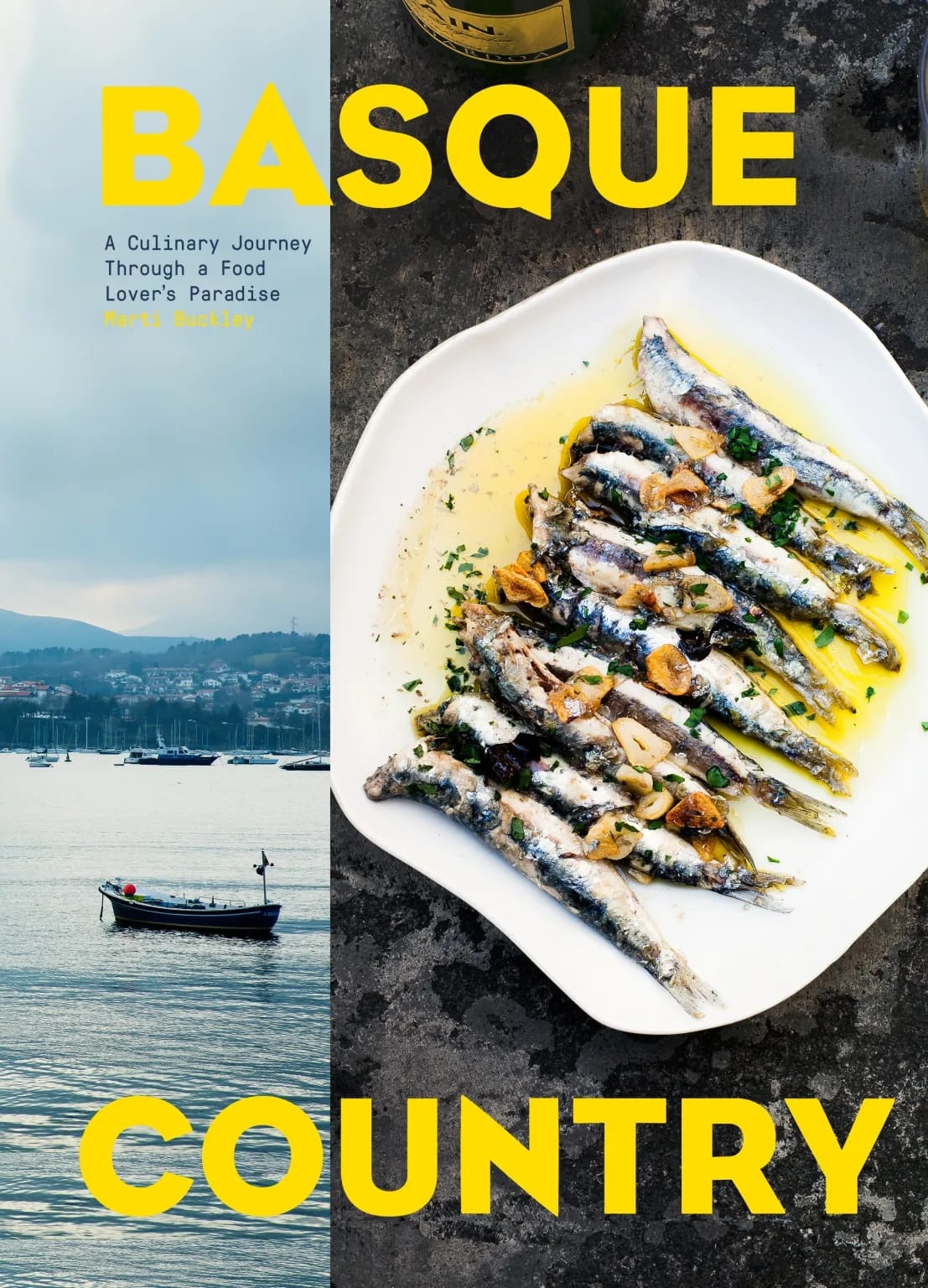
These drinks are inseparable from the Basque table: txakoli and cider in the pintxo bars and sagardotegis, patxaran and vermouth as bookends to a meal. For a good introduction to that culture, Marti Buckley’s Basque Country: A Culinary Journey Through a Food Lover’s Paradise (Artisan, 2018; IACP Cookbook Award 2019, International category; Best Publication, Basque Gastronomy Academy) is followed by her The Book of Pintxos (Artisan, 2024) on the bar-counter tradition specifically. Buckley writes from San Sebastián at travelcookeat.com and on Instagram at @martibuckley.
Sources
La Cocina Vasca | Marti Buckley – May 5, 2021
Related Reading
- Paddy Woodworth – The Basque Country: A Cultural History (Signal Books / Oxford University Press, 2007–08): a cultural survey by a journalist with thirty years covering the region.
- Mark Kurlansky – The Basque History of the World: The Story of a Nation (Penguin, 1999): history with recipes; chapters on whaling, cod and Gernika supply the deep context for the coast’s food culture.
→ Also on tessender.com: Wine Region Notes: Corpinnat (Barcelona)
Last updated: July 2026